
FY2025 Q4 Report
This report summarizes high-level capital spending, ridership, and train performance information over the past quarter along the Northeast Corridor. The NECC follows the federal fiscal year. Q4 is from July 1 - September 30.
Highlights include:
- Agencies invested $5.0B in infrastructure renewal and replacement in FY25, a record for the corridor.
- Average weekday and weekend ridership increased by 2.5% compared to FY24Q4, with VRE recording a YoY ridership increase of 69%, and NJT and MARC both recording growth above 10%
- 10.3% of all trains were late, annulled, or terminated, a 0.3 percentage point decrease compared to FY24Q4.
Hover your mouse over graphs to look at specific information, or click dropdowns and toggles where they exist to filter data to certain agencies.
Capital Spending
Year to date in FY25, NEC agencies have invested $5.0B in infrastructure. This is the highest combined Q1-Q4 spend in NEC history.
FY25Q4 Spend
▲ $171.3M vs. same quarter last FY
Ridership and Service
In the graphic below, you can select or unselect different agencies in the 'Agency Selection' box, and you can toggle between weekend or weekday ridership with the adjacent dropdown. Note that changes affect both the Ridership graphic and the Trains graphic below. Totals are annotated for the highest and lowest quarters, as well as the current quarter.
Q4 Average Weekday Ridership
▲ 37,766 riders vs. same quarter last year
Q4 Average Weekday Passenger Trains
▼ -2 Trains vs. same quarter last year
Overall, NEC ridership increased by 2.5% year-over-year.
While there was a steady increase in ridership corridor wide, the strongest YoY growth was recored by VRE (69%), followed by NJT and MARC, both with growth above 10%. MBTA recorded the largest decrease of approximately 8%.
Average weekday service levels on corridor remained consistent year-over-year.
However weekend services have increased considerably year-over-year, with increases driven by SEPTA and LIRR.
Train Performance
On-time Performance
In FY25Q4 10.3% of NEC trains were late, annulled, or terminated, a 0.3 percentage point decrease compared to FY24Q4. SEPTA, and CTrail, recorded the largest increase year-over-year in late trains of 2.0, and 1.7 percentage points respectively, while VRE and Amtrak recorded the largest reductions of 10.8 and 3.4 percentage points respectively. All other operators had year-over-year changes under 1 percentage point.
Note: FY25Q4 train delay data does not include MARC services
Delay Causes
Note: FY25Q4 train delay data does not include MARC services
Train-delay Minutes
Train-delay minutes in FY25Q4 were spread throughout the quarter, with significant delays on July 16th from a trespasser strike, and August 1st and September 11th from catenary failures.
Note: FY25Q4 train delay data does not include MARC services
Major Service Incidents
Commission staff use a threshold of 5,000 total train-delay minutes or 1,500 infrastructure train-delay minutes
to identify days which may have had major service incidents that disrupted service. Daily operations
reports are reviewed to uncover any major service incidents that affected train performance. Those
incidents are then compared with train delay records to quantify their impact. Ten major service
incidents were identified in FY25Q4.
Note: FY25Q4 train delay data does not include MARC services

Spotlight: NextGen Acela Fleet Service Introduction
NextGen Acela fleet will bring intercity frequency and capacity enhancments to the NEC
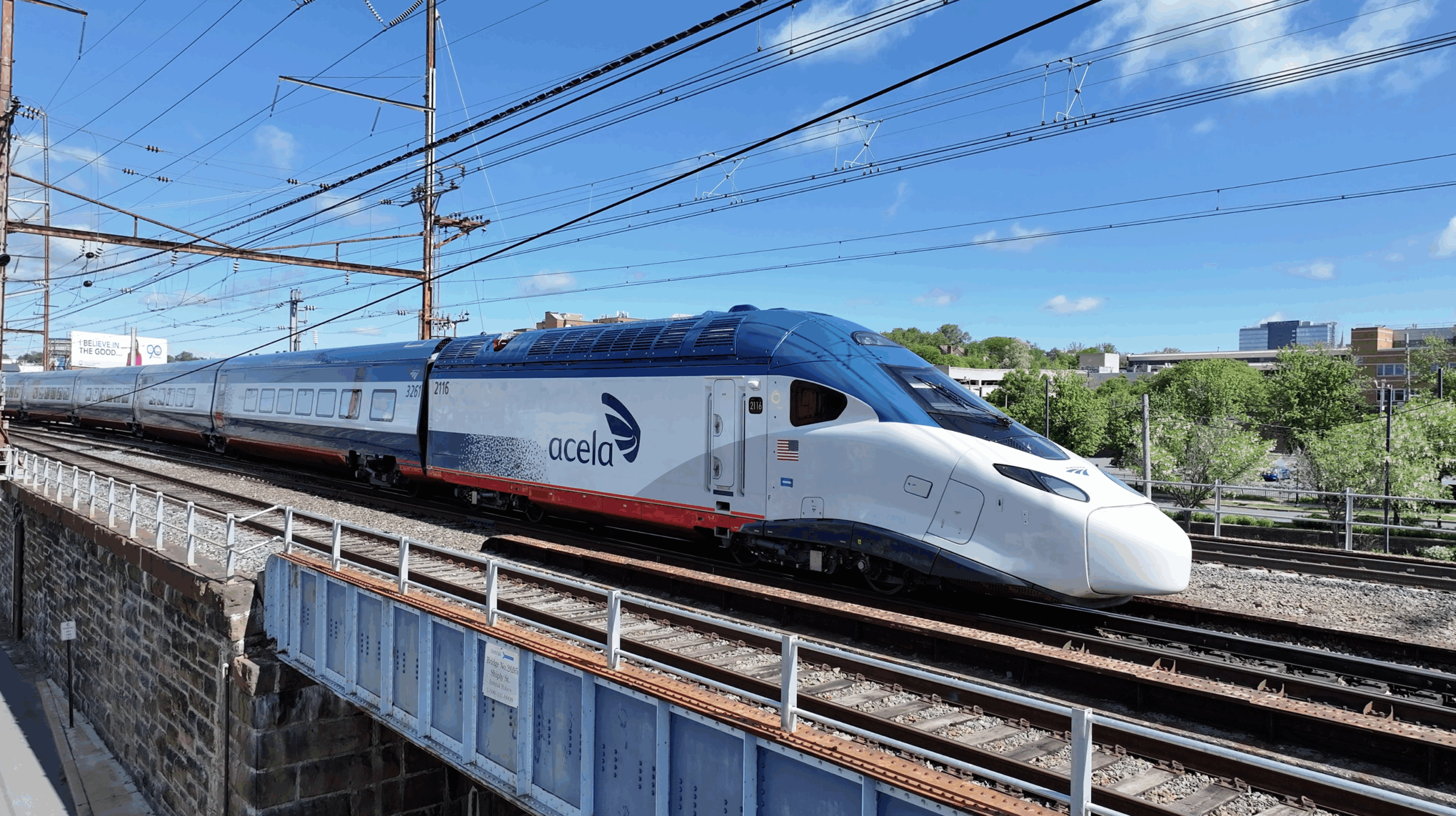
Amtrak’s NextGen Acela trainsets entered revenue service this quarter, with the first five trainsets entering revenue services on August 28th, 2025.
A total of 24 NextGen Acela trainsets will be introduced throughout 2026, with the full fleet of 28 trainsets operational by 2027, replacing the 20 original Acela trainsets that have been in operation since 2000.
The $2.3 billion New Acela program began in 2014, with contracts awarded to Alstom in 2016 and plans to enter service in May 2021. However, as the first made-in-America high speed trains built under international standards, the new trainsets were also the first to be certified under the Federal Railroad Administration’s (FRA) new Tier III rule, which sets updated safety standards for high speed trains. Meeting these requirements required continual refinement of Alstom’s analysis, simulation, and testing activities. In addition, COVID 19 restrictions and supply chain disruptions further contributed to delays in the original schedule.
The delays required Amtrak to keep the existing Acela fleet in service four years longer than originally planned, and during this time there was a considerable increase in mechanical failures. In 2019, four of the original Acela trainsets were decommissioned, which enabled Amtrak to use their parts to keep the remaining 16 trainsets running. This led to a reduction in Acela services from an average of 33 daily weekday trains in FY19, to 24 in FY25.
From their introduction at the end of August to the end of Q4, over 60K trips were taken on the NextGen Acela, and passengers benefited from improved ride quality, 5G-enabled Wi-Fi, enhanced on-board dining, and new at seat amenities such as individual USB ports, power outlets, and reading lights. The larger fleet will allow for an increase in Acela services, and with 27% more seats per train Amtrak projects that by FY30 the additional capacity will increase Acela ridership by more than 50%.