
FY2026 Q1 Report
This report summarizes high-level capital spending, ridership, and train performance information over the past quarter along the Northeast Corridor. The NECC follows the federal fiscal year. Q1 is from October 1 - December 31.
Highlights include:
- Agencies invested $1.3B in infrastructure renewal and replacement in FY26Q1, a record for the corridor.
- Average weekday and weekend ridership increased by 2.1% compared to FY25Q1, with VRE recording a YoY ridership increase of 27%, and CTrail and MARC both recording growth above 10%
- 11.1% of all trains were late, annulled, or terminated, a 0.7 percentage point increase compared to FY25Q1.
Hover your mouse over graphs to look at specific information, or click dropdowns and toggles where they exist to filter data to certain agencies.
Capital Spending
Year to date in FY26, NEC agencies have invested $1.3B in infrastructure. This is the highest Q1 spend in NEC history.
FY26Q1 Spend
▲ $135.5M vs. same quarter last FY
Ridership and Service
In the graphic below, you can select or unselect different agencies in the 'Agency Selection' box, and you can toggle between weekend or weekday ridership with the adjacent dropdown. Note that changes affect both the Ridership graphic and the Trains graphic below. Totals are annotated for the highest and lowest quarters, as well as the current quarter.
Q1 Average Weekday Ridership
▲ 15,666 riders vs. same quarter last year
Q1 Average Weekday Passenger Trains
▼ -17 Trains vs. same quarter last year
Overall, NEC ridership increased by 2.1% year-over-year.
While overall corridor ridership remained consistent, the strongest YoY growth was recorded by VRE (27%), followed by CTrail and MARC, both with growth above 10%. SEPTA recorded the largest decrease of 16%.
Average weekday and weekend service levels on-corridor reduced slightly YoY.
The reduction is attributable to planned track replacement work on MBTA’s Fairmount Line which necessitated a drop in train services.
Train Performance
On-time Performance
In FY26Q1 11.1% of NEC trains were late, annulled, or terminated, a 0.7 percentage point increase compared to FY25Q1.
SEPTA, and CTrail, recorded the largest increase year-over-year in late trains of 5.3, and 3.6 percentage points respectively, while VRE and Amtrak recorded the largest reductions of 6.9 and 5.7 percentage points respectively. All other operators had year-over-year changes under 2 percentage points.
Delay Causes
Train-delay Minutes
Train-delay minutes in FY26Q1 were spread throughout the quarter, with significant delays on December 5th from a catenary failure, and October 30th and December 14th-15th from weather events.
Major Service Incidents
Commission staff use a threshold of 5,000 total train-delay minutes or 1,500 infrastructure train-delay minutes
to identify days which may have had major service incidents that disrupted service. Daily operations
reports are reviewed to uncover any major service incidents that affected train performance. Those
incidents are then compared with train delay records to quantify their impact. Ten major service
incidents were identified in FY26Q1.

Spotlight: What Causes Late Trains on the NEC?
More than 2,000 trains traverse portions of the Northeast Corridor (NEC) each day, making it the busiest passenger rail line in North America. Being late is defined differently for intercity and commuter trains to account for their different passenger needs, stopping patterns, and route lengths. On the NEC, a commuter train is considered late if it is more than six minutes behind schedule. For most Amtrak trains (i.e., intercity services), including Acela, Northeast Regional, and Keystone trains, delays exceeding 16 minutes are classified as late.
In FY25, approximately 9% of commuter trains and 25% of Amtrak intercity trains on the NEC arrived at their final destinations late due to a variety of causes (see Major Causes of NEC Delay in FY25 table).
One train delay can create cascading disruptions for other trains operating on the NEC, classified as transportation delays. For instance, a delay may begin with an infrastructure or mechanical issue which impacts a few trains. With so many trains sharing the same infrastructure, a late running train may delay other trains waiting to access the same track sections, a delay commonly called train interference. Additionally, when delayed trains reach the end of their route, there often isn’t enough time to swap the crew, prepare the train for the return journey, and depart on schedule. This is classified as a late crew and/or equipment swap.
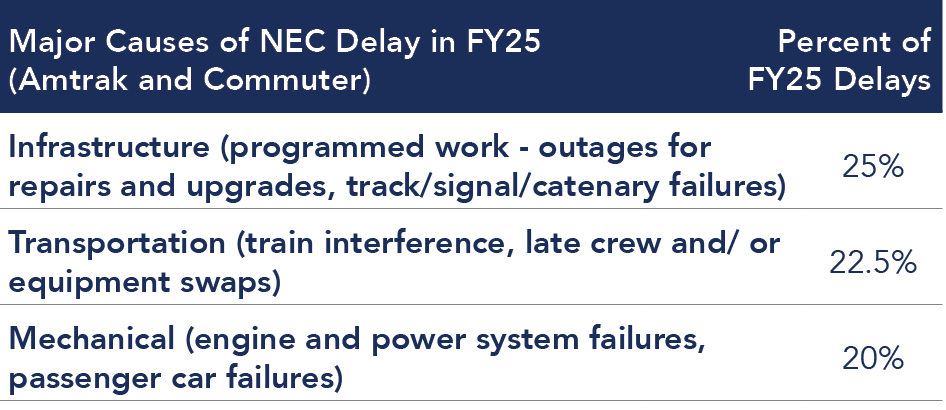
It’s critically important to keep trains on the NEC running on time. Ongoing delays can reduce ridership and undermine customer satisfaction, as well as causing wider economic consequences. The NEC is the backbone of the regional economy, supporting hundreds of millions of trips annually and connecting major economic hubs from Washington, D.C. to Boston, MA. Northeast Corridor Commission analysis shows that an unplanned shutdown of the NEC would cost the American economy more than $170 million per day.
While some delays are difficult or impossible to address (e.g., weather), NEC stakeholders are working to address infrastructure and mechanical delays through state-of-good-repair investments and fleet upgrades. Continued delivery of these investments will mean fewer delays and more reliable service over time.