
FY2026 Q2 Report
This report summarizes high-level capital spending, ridership, and train performance information over the past quarter along the Northeast Corridor. The NECC follows the federal fiscal year. Q2 is from January 1 - March 31.
Highlights include:
- Agencies invested $1.2B in infrastructure renewal and replacement in FY26Q2, The highest Q1 and Q2 spend in NEC history.
- Average weekday and weekend ridership decreased by 2.5% compared to FY25Q2, with SEPTA recording a YoY ridership decrease of 18%, but with MARC and MBTA both recording growth of 7%
- 13.5% of all trains were late, annulled, or terminated, a 3.7 percentage point increase compared to FY25Q2.
Hover your mouse over graphs to look at specific information, or click dropdowns and toggles where they exist to filter data to certain agencies.
Capital Spending
Year to date in FY26, NEC agencies have invested $1.3B in infrastructure. This is the highest Q1 and Q2 spend in NEC history.
FY26Q2 Spend
▲ $181.2M vs. same quarter last FY
Ridership and Service
In the graphic below, you can select or unselect different agencies in the 'Agency Selection' box, and you can toggle between weekend or weekday ridership with the adjacent dropdown. Note that changes affect both the Ridership graphic and the Trains graphic below. Totals are annotated for the highest and lowest quarters, as well as the current quarter.
Q2 Average Weekday Ridership
▼ -17,216 riders vs. same quarter last year
Q2 Average Weekday Passenger Trains
▼ -40 Trains vs. same quarter last year
Average daily weekday and weekend NEC ridership decreased by 2.5% year-over-year (YoY).
CTrail recorded the strongest YoY growth (12%), followed by MARC and MBTA, both with growth of 7%. SEPTA recorded the largest decrease of 18%.
Average on-corridor service levels declined YoY due to severe winter weather disrupting train schedules, and construction of the Long Bridge project necessitating a reduction in on-corridor VRE services.
Train Performance
On-time Performance
In FY26Q2 13.5% of NEC trains were late, annulled, or terminated, a 3.7 percentage point increase compared to FY25Q2.
All operators had a year-over-year increase of at least 1.9 percentage points, partially attributable to severe winter weather caused by two storms impacting the corridor.
MBTA, and VRE, recorded the largest increase year-over-year in late trains of 8.0, and 3.9 percentage points respectively, while SEPTA and CTrail recorded the smallest increases of 1.9 and 2.0 percentage points respectively.
Delay Causes
Train-delay Minutes
Significant delays occurred from January 25th – 27th, when winter storm Fern impacted the corridor causing a near-total NEC shutdown on January 26th. Significant residual delays persisted until January 30th as agencies worked to restore service in freezing conditions. The NEC was affected by a second winter storm from February 23rd – 24th, leading to another near-total shutdown on February 24th. However, service was restored more quickly than during the previous storm.
Major Service Incidents
Commission staff use a threshold of 5,000 total train-delay minutes or 1,500 infrastructure train-delay minutes
to identify days which may have had major service incidents that disrupted service. Daily operations
reports are reviewed to uncover any major service incidents that affected train performance. Those
incidents are then compared with train delay records to quantify their impact. Ten major service
incidents were identified in FY26Q2.

Spotlight: First track of Portal North Bridge enters service
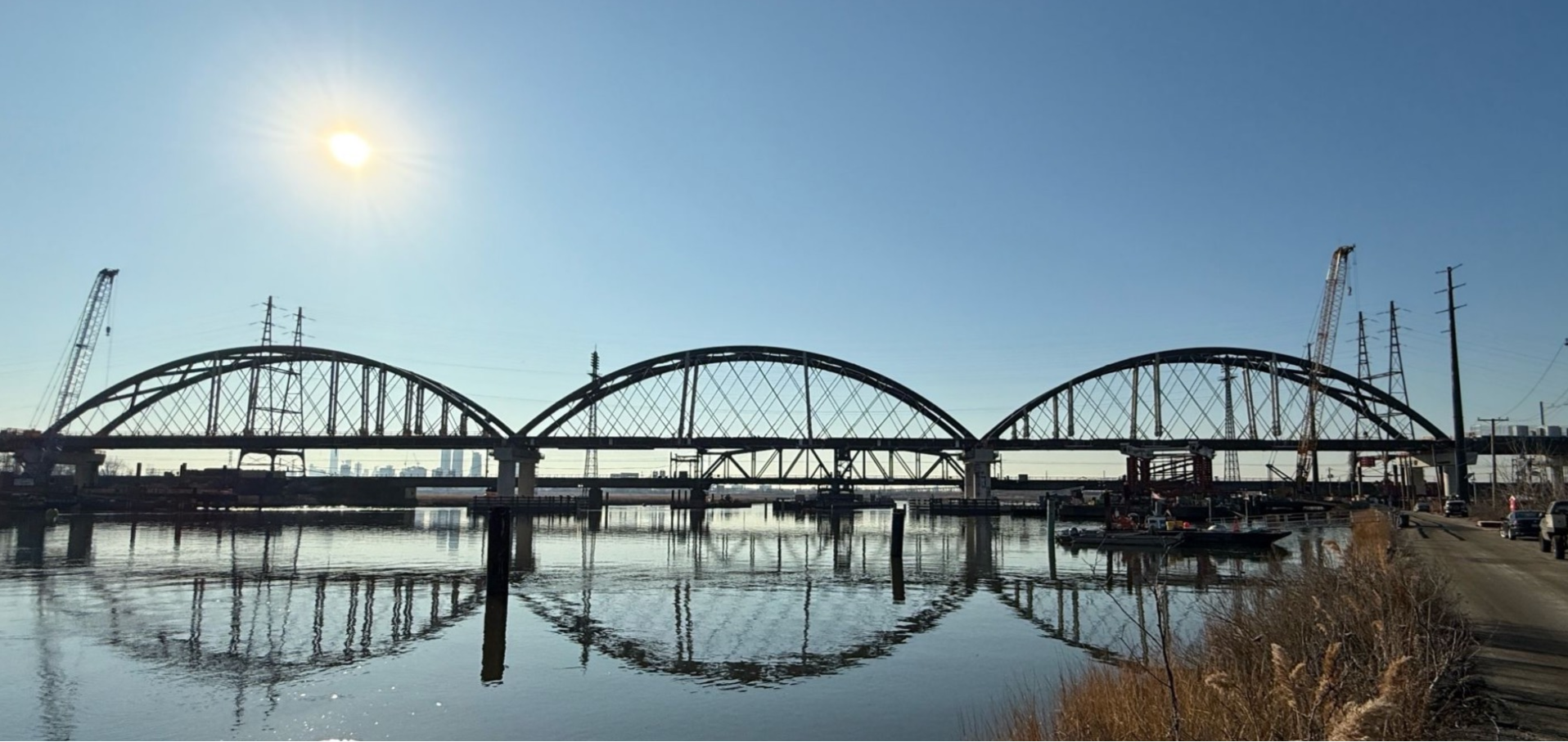
On March 16, 2026, the first track of the new Portal North Bridge (PNB) officially entered revenue service, a significant milestone for the Northeast Corridor (NEC) and one of many similar milestones anticipated in the coming years. The project has progressed thanks to the collaborative planning and investment occurring among NEC stakeholders, including the US Department of Transportation, NJ TRANSIT (NJT), and Amtrak.
The PNB project, which is nearing completion, is being led by NJT in partnership with Amtrak. In 2021, NJT announced a $1.56B construction contract for the bridge, the largest construction contract in NJT’s history. Funding Included a $766.5M Federal Transit Administration Capital Investment Grant. Spanning the Hackensack River, the bridge is situated within one of the busiest sections of the NEC, between Newark and New York Penn Station. More than 450 Amtrak and NJT trains cross the existing bridge each day, carrying over 200,000 passengers and serving as a critical link in the region’s transportation network.
The original movable Portal Bridge, constructed in 1910, has long been a major source of delay due to required openings for marine traffic and recurring mechanical failures. Due to its advanced age and deteriorated condition, the bridge fails to close in approximately one out of every seven openings. Addressing the mechanical failures requires maintenance crews to intervene on site, which frequently cause additional delays.
In FY25 alone, Portal Bridge caused two major service incidents when it failed to close properly, resulting in severe and widespread delays along the NEC and delaying a total of 160 trains. In addition, over the last ten years the bridge has caused an estimated 143,000 minutes of train delay, equating to over 44,000 hours of passenger delay per year for Amtrak and NJT customers.
To eliminate openings and closings, PNB was designed as a fixed (non-opening) two-track bridge that rises 50 feet above the Hackensack River. This design allows marine traffic to pass beneath the bridge without interrupting rail operations and permits track speed to increase from 60 to 90 mph. The bridge will become fully operational once the second track enters service in Fall 2026 and the old bridge will be decommissioned and demolished.