
FY2026 Q3 Report
This report summarizes high-level capital spending, ridership, and train performance information over the past quarter along the Northeast Corridor. The NECC follows the federal fiscal year. Q3 is from April 1 - June 30.
Highlights include:
- Agencies invested $1.5B in infrastructure renewal and replacement in FY26Q3, The highest Q1 - Q3 spend in NEC history.
- Average weekday ridership remained constant, and weekend ridership increased by 1.5% compared to FY25Q3.
- 12.3% of all trains were late, annulled, or terminated, a 1.5 percentage point increase compared to FY25Q3.
Hover your mouse over graphs to look at specific information, or click dropdowns and toggles where they exist to filter data to certain agencies.
Capital Spending
Year to date in FY26, NEC agencies have invested $1.3B in infrastructure. This is the highest Q1 - Q3 spend in NEC history.
FY26Q3 Spend
▲ $54.0M vs. same quarter last FY
Ridership and Service
In the graphic below, you can select or unselect different agencies in the 'Agency Selection' box, and you can toggle between weekend or weekday ridership with the adjacent dropdown. Note that changes affect both the Ridership graphic and the Trains graphic below. Totals are annotated for the highest and lowest quarters, as well as the current quarter.
Q3 Average Weekday Ridership
▼ -1,359 riders vs. same quarter last year
Q3 Average Weekday Passenger Trains
▲ 25 Trains vs. same quarter last year
Average daily NEC weekday ridership remained constant and weekend ridership increased by 1.5% year-over-year (YoY).
MBTA recorded the strongest YoY growth (10%), followed by CTrail and Amtrak, both with growth of 7%. VRE and SEPTA recorded the largest decreases of 26% and 11% respectively.
Average weekday on-corridor service levels increased YoY due to additional Amtrak services. In contrast weekend service levels declined YoY due to programmed work on the Metro-North New Canaan branch and MBTA Old Colony Lines.
Train Performance
On-time Performance
In FY26Q3 12.3% of NEC trains were late, annulled, or terminated, a 1.5 percentage point increase compared to FY25Q3.
VRE, and NJT recorded the largest increase year-over-year in late trains of 11.8, and 5.6 percentage points respectively, while Amtrak and CTrail recorded the largest decrease of 4.2 and 3.2 percentage points respectively.
Delay Causes
Train-delay Minutes
Significant delays occurred on May 20th, when two brush fires occurred in succession on the NYP line between Philadelphia and New York causing suspension of rail services while the fires where extinguished. New York Penn Station was impacted by two fires during the quarter, the first on May 14th, and the second on May 29th causing widespread disruption to rail services. The NEC was affected by a significant catenary power failure from New Rochelle to South Norwalk on June 7th impacting Amtrak and MNR trains.
Major Service Incidents
Commission staff use a threshold of 5,000 total train-delay minutes or 1,500 infrastructure train-delay minutes
to identify days which may have had major service incidents that disrupted service. Daily operations
reports are reviewed to uncover any major service incidents that affected train performance. Those
incidents are then compared with train delay records to quantify their impact. 12 major service
incidents were identified in FY26Q3.

Spotlight: Hartford Line Rail Program Progress
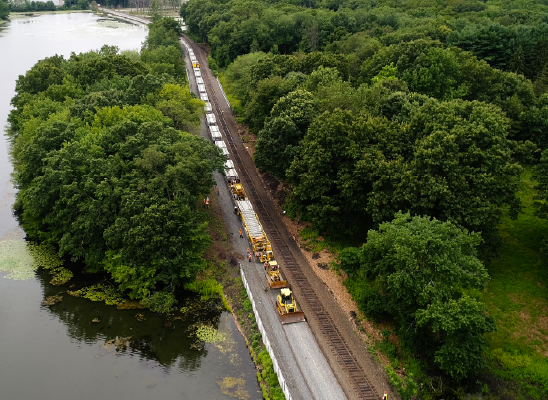
The State of Connecticut, with support of the federal government, has invested over $1 billion into the Hartford Line Rail Program to increase passenger rail service frequency along the line, and address the current and future intercity transportation needs of Connecticut, Massachusetts, and Vermont. Through this investment, Connecticut DOT has restored 27 miles of double-track, upgraded signaling and interlockings, improved existing stations, and constructed new stations in Berlin, Meriden, and Wallingford. These improvements laid the foundation for the launch of CTrail Hartford Line service in 2018 and enabled significant increases in service frequency, reliability, and ridership.
Since April, Amtrak and CTrail have been operating a modified timetable between New Haven and Springfield which will remain in effect through October to accommodate the latest phase of the Hartford Line Rail Program. This phase includes construction of the new Windsor Locks Station and track improvements necessary to support the new station. During this period, buses are replacing six CTrail and three Amtrak mid-day trains between Hartford and Springfield to minimize passenger impacts and allow most services to operate normally while providing work crews with railway access. This operational change is the latest in a series of bus substitutions that have taken place on the line in recent years. Despite these temporary service disruptions, the Hartford Line has continued to attract new riders. CTrail Hartford Line ridership reached a record of 25,000 average monthly passengers in FY26Q3.
Future phases of the Hartford Line Rail Program will continue to advance infrastructure improvements along the New Haven – Springfield corridor. Planned investments include construction of a new station in Enfield, 6.75 miles of additional double track, and design to support the relocation of Hartford Station.
In addition to these infrastructure upgrades, CTrail will introduce a new fleet of rolling stock in 2027 that will provide additional passenger capacity, ADA-compliant restrooms, real-time information displays, and other improvements. Together, these investments will improve accessibility, expand access to the rail network, strengthen multimodal connectivity, and support continued growth in ridership.